ULTRAWATER – Excellence for Metering Intelligence
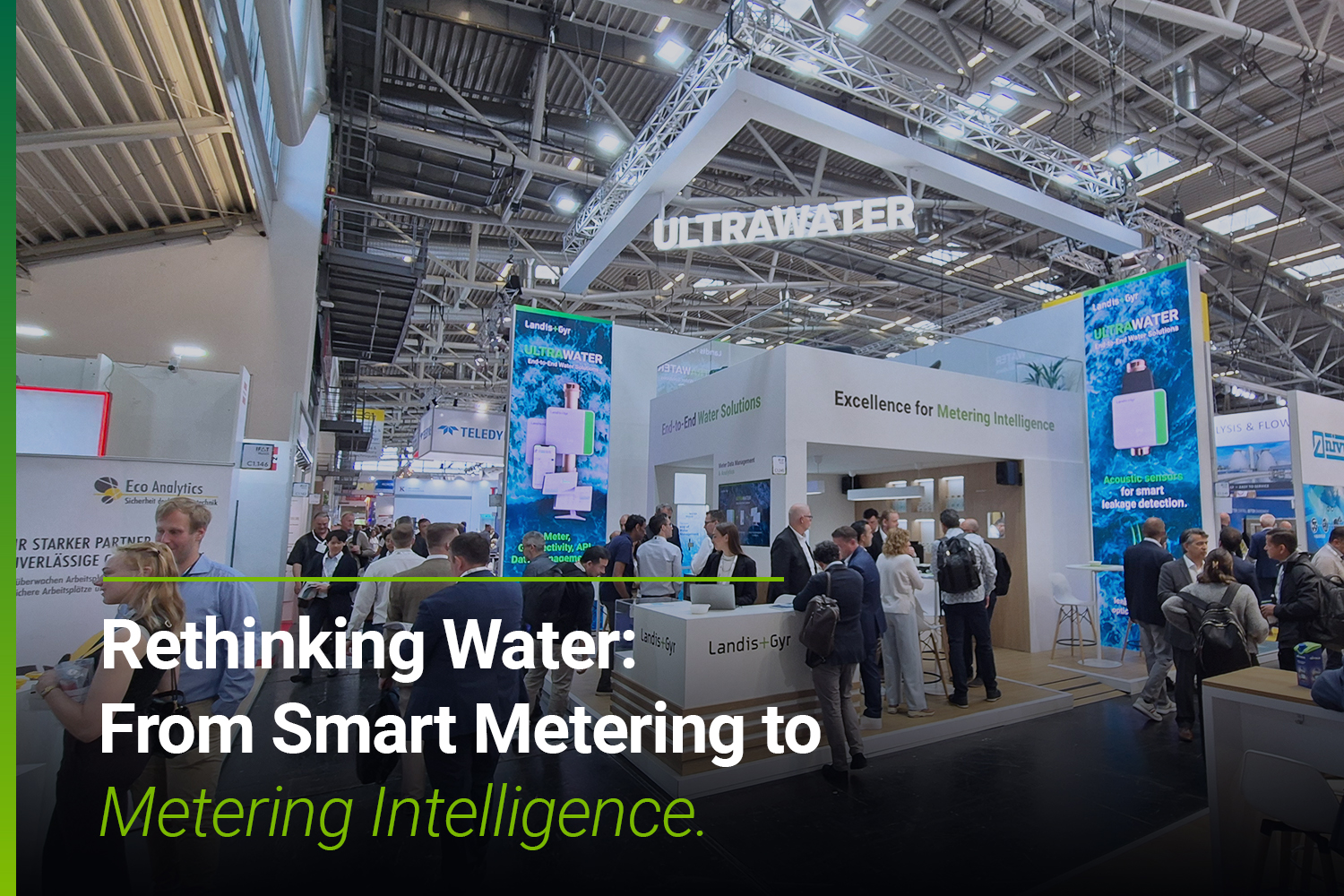
At IFAT 2026 in Munich, Landis+Gyr EMEA presented its ULTRAWATER ultrasonic meters. On the Green Stage,
Johannes M. Koch outlined why water and energy can no longer be treated as separate systems and what that means
for the infrastructure of tomorrow.
The Moment the Industry Has Been Waiting For
IFAT 2026 in Munich, the world's leading trade fair for water, waste and raw materials management, carried an unmistakable
message this year: the water industry has reached a structural turning point. Johannes M. Koch, VP Thermal Energy & Water Metering Solutions
and Managing Director of Landis+Gyr GmbH, captured it precisely in his talk on the Green Stage. The challenges have grown.
The regulatory response is well underway. And digital convergence is no longer optional, it is inevitable.
Climate change, urbanisation, ageing infrastructure, rising operational costs and shrinking technical workforces: the pressure points
Johannes M. Koch outlined in his opening slide are not abstract future scenarios. They define the day-to-day reality of most water
utilities across Europe today. With the EU Water Resilience Strategy, the Cyber Resilience Act (CRA) and the Ecodesign for
Sustainable Products Regulation (ESPR), the European Commission has set a regulatory framework that demands faster
action than many utilities had planned for.
The conclusion is clear: fragmented planning no longer works. The water/energy nexus is intensifying. Total cost of ownership
is becoming the dominant metric for investment decisions. And digital convergence is unavoidable.
Water and Energy: Two Systems, One Fate
Perhaps the strongest conceptual argument in the presentation was the case for convergence between water and energy systems.
Johannes M. Koch illustrated that up to two kilowatt hours of energy are embedded in every cubic metre of water that is
pumped and treated. Carbon emissions, cost and supply reliability are therefore directly linked.
Pumping stations are energy consumers. Leakage is simultaneously water loss and energy waste. When energy prices spike
or renewable generation fluctuates, water networks feel it immediately. Utilities that continue to plan and operate both systems
in silos forgo the opportunity to optimise across them. Integrated planning, as Johannes M. Koch argued, enables carbon-aware
operations and greater resilience. Meters acting as data providers are the key enabler of that integration.
ULTRAWATER: Ultrasonic Meters as the Data Foundation for Intelligent Network Operations
At the Landis+Gyr EMEA booth, the ULTRAWATER ultrasonic meters took centre stage. What sets them apart from conventional
metering points is not the measurement technology alone, but the role they play in an intelligent network. No moving parts, no
mechanical drift, no loss of accuracy over time: ultrasonic measurement delivers stable, precise readings throughout the entire device lifetime.
For connectivity, the ULTRAWATER ultrasonic meters support NB-IoT, LoRaWAN and wM-Bus, enabling seamless integration
into both new and existing infrastructure. An optional acoustic leak detection sensor allows utilities to locate losses within the
distribution network before significant damage occurs. With a battery life of up to 15 years and intelligent battery management,
the devices minimise maintenance effort and total cost of ownership.
From Smart Metering to Metering Intelligence
The industry is currently undergoing a transformation, shifting away from isolated operational processes, purely transactional
meter reading, and reactive analysis, toward open, interoperable platforms featuring a continuous intelligence loop and real-time
predictive capabilities. Holistic monitoring uncovers hidden inefficiencies benefiting both utility companies and end consumers alike.
It establishes the foundation for predictive maintenance, load management, and the reduction of grid losses. The result is lower CO²
emissions, reduced water losses, and declining total operating costs. The chain extending from the meter, through the communication
module and data management systems, all the way to the analytics layer, demonstrates this point compellingly: the true added value
lies not solely in the device itself, but in the data flow it enables.
Cybersecurity: Not an IT Issue, but an Operational Risk
A particular focus lies on cybersecurity in water metering. With increasing connectivity, meters are evolving into critical entry
points into the network. Therefore, security must be firmly embedded within the device from the very outset, rather than merely
being added as an afterthought. Device security ensured through "Secure Boot" and encrypted firmware, data security via end-to-end
encryption extending from the meter to the cloud, operational stability designed to prevent service interruptions, and compliance with
regulatory requirements regarding data protection and critical infrastructure constitute the fundamental pillars of both the present and the future.
His core message precisely encapsulated the gravity of the situation: A compromised meter is not merely an IT problem, but an operational risk.
The Future of Water Is Already Being Built
“The future of water is integrated, intelligent, secure, and inextricably linked with energy and this future is already being built.”
For Landis+Gyr EMEA, IFAT 2026 provided the opportunity to bring this vision to life. The ULTRAWATER ultrasonic meters
represent a metering technology that goes beyond the device itself, making water networks smarter, more efficient, and more secure.
The response from trade visitors made one thing clear: The water industry is ready for this step.
Watch the Green Stage Presentation HERE.
